
The latest PMI showed inflation pressures ebbed further last month with both costs of raw material and prices charged rising at a slower pace than March.

Index heavyweights continue to be top losers with ICICI bank.
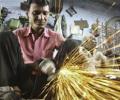
Economic recovery in US, euro zone help; new orders sub-index at 52.4
Manufacturing output, which constitutes about 76 per cent of the industrial production, fell by an annual 6 per cent, the Statistical Office said.

Focusing on low GDP growth in recent years, therefore, masks the deeper crisis facing manufacturing and mining.

India's services sector activities eased to a three-month low in April, as the rise in business activity was constrained by the pandemic and sentiment towards growth prospects faded, a monthly survey said on Wednesday. The seasonally adjusted India Services Business Activity Index fell to 54 in April from 54.6 in March, the slowest increase in output in three months. In PMI parlance, a print above 50 means expansion while a score below 50 denotes contraction.

'When manufacturing or even services cannot generate the kind of employment they are looking for, they prefer to be unemployed rather than under-employed.'

The stock market is likely to continue with its positive momentum but may face bouts of profit-booking amid lofty valuations in this holiday-shortened week, analysts said. The trading sentiment will be guided mostly by global trends in absence of major domestic events, they said. Markets would remain closed on Friday for 'Ganesh Chaturthi'.

Finance Minister Arun Jaitley is expected to present the Budget for 2014-15 in July.
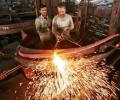
The November IIP has been revised upwards to 3.9% from 3.8%.
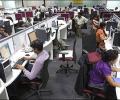
In five years, per-employee revenue for IT companies grew at 9 per cent each year.
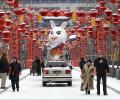
In a major sign of transformation of manufacturing-dominated Chinese economy, annual output of its service sector may exceed that of the manufacturing sector for the first time ever in 2013, an expert said.
India's industrial output rose 5.8 per cent in the year to March 2003 boosted by a robust manufacturing sector despite fears the country's worst drought in 15 years would hurt demand in Asia's third-largest economy.
A surge in manufacturing pushed up the country's industrial growth to 12.9 per cent in March 2007, taking the expansion during 2006-07 to 11.3 per cent.

The HSBC Emerging Markets Index, a monthly indicator derived from Purchasing Managers' Index surveys, inched up to 50.6 in May from 50.4 in April, indicating weak output growth across global emerging markets.

Ford, which had announced to quit the Indian market last year, said it was exploring the possibility of using one of its plants in India to produce electric cars for exports.
.jpg)
The HSBC Emerging Markets Index, a monthly indicator derived from the PMI surveys, sank to 50.6 in June from 51.3 in May, signalling the weakest increase in output since May, 2009.
Pointing out that loosening cycle of monetary policy by RBI began only in October, Moody's said, it might not have led to an immediate rebound in domestic consumption. However, the RBI on Thursday stated that monetary measures taken by it were 'appropriate'.

Reliance Industries would repair a third of the wells shut at its main gas field in the eastern offshore KG-D6 block to boost output in the first quarter of 2014.

The manufacturing sector, which constitutes over 75 per cent of the index, declined by 2 per cent in October as against a growth of 9.9 per cent a year ago.

Although growth picked up slightly across the world's main emerging markets on an average, rates of expansion remain subdued

The first economic readings to be published in 2015 will be out on Monday, when the government releases industrial output data for November and the consumer price index for December.

As per the first advance estimates of national income released by the National Statistical Office (NSO) on Friday, the manufacturing sector output is estimated to grow to 6.5 per cent in the current fiscal compared to 1.3 per cent in 2022-23. Similarly, mining sector growth is estimated at 8.1 per cent in the current fiscal against 4.1 per cent in 2022-23.
India was already in the midst of a protracted economic slowdown before the virus hit due to a festering crisis among shadow lenders and declining consumer demand and private investment. Service sector activity in India is still effectively on hold.

The Nifty closed at 5,137, up three points. The market breadth turned weak at close. Out of 2,921 stocks traded on the BSE, there were 1,037 advancing stocks as against 1804 declines.

The ministry of statistics and programme implementation on Friday released quick estimates of the Index of Industrial Production (IIP) which showed the index value at 88.4 in May against 53.6 in April, indicating a graded pickup in industrial activity. The index stood at 135.4 in May 2019.

Chief Economic Advisor (CEA) V Anantha Nageswaran on Thursday said describing India's recovery as 'K-shaped' was wrong as both rural and urban economies were recovering, albeit at different paces. Speaking to reporters at the Finance Ministry, Nageswaran said the gross domestic product (GDP) growth print for the recent October-December quarter (Q3FY23) will likely be revised upwards. "The notion of using the letter 'K' to denote urban and rural is somewhat wrong because it is almost as if one is growing and one is contracting. "I would say one segment's slope is more positive, and the other one slope is less positive but it is positive," Nageswaran said.

Among the Sensex firms, Asian Paints, Tata Steel, HCL Technologies, Nestle, Maruti, JSW Steel, NTPC and Larsen & Toubro were the major laggards. Sun Pharma, Bajaj Finserv, Reliance Industries, State Bank of India and Bharti Airtel were the gainers.
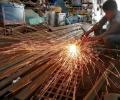
India's industrial production slipped to an 18-month low, contracting by 0.8 per cent in August, mainly due to a decline in output of the manufacturing and mining sectors, according to official data released on Wednesday. The data showed that the previous low in industrial output growth was a contraction of 3.2 per cent in February 2021. Factory output, measured in terms of the Index of Industrial Production (IIP), had expanded by 13 per cent in August 2021. The IIP grew by 2.2 per cent in July this year.

SII would be scaling up its AstraZeneca-Oxford vaccine manufacturing capacity to 200 million doses a month from 100 million a month now, reports Sohini Das.
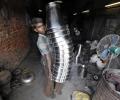
Factory growth picked up in May.

India's manufacturing sector activity contracted for the second consecutive month in September as both output and new orders witnessed a decline, an HSBC survey said.

This apart, to further increase capacities, Bharat Biotech has partnered with Indian Immunologicals (IIL) to manufacture the drug substance for Covaxin. The technology transfer process is underway and IIL has the 'capabilities and expertise' to manufacture the inactivated viral vaccines at commercial scale.
.jpg)
The subdued labour market is likely to recover.

But Indians work less than smaller countries with small populations like Bhutan, the Congo, Lesotho and Gambia.

The recovery in manufacturing is still likely to prove "protracted" given the lingering structural constraints.
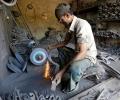
Supported by greater demand from both domestic and external markets, total new business rose at the fastest pace since March
India's industrial output grew 9.7 per cent in August compared to 7.6 per cent in the same month last fiscal.\n\n

SBI was the top loser in the Sensex pack, shedding over 1 per cent, followed by Reliance Industries, Tech Mahindra, M&M, L&T, Bharti Airtel, IndusInd Bank and HDFC. NSE Nifty slipped 31.60 points to 15,824.45.
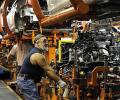
Regarding employment, the manufacturing sector hiring remained broadly unchanged.
